Minds in Motion: The Science and Vision of Movement-Based Education
Discover why movement is not just a physical activity, but the essential key to cognitive, emotional, and social growth in the modern era.
In today's rapidly changing world, one of the most fundamental yet often overlooked needs in a child's developmental journey is movement. At Blue Planet Child Care, our vision transcends traditional "care." We view movement not merely as physical exercise, but as the cornerstone of learning, social bonding, and emotional regulation.
The Science of Learning: Why Movement Matters
Historically, movement and cognitive processes (thinking and learning) were seen as two separate functions. However, modern neuroscience has proven that motor development and cognitive growth are deeply intertwined.
Research led by Adele Diamond (2000) highlights that the part of the brain responsible for motor skills (cerebellum) and the part responsible for high-level thinking (prefrontal cortex) are directly connected. When a child walks on a balance beam, they aren't just training muscles; they are training their focus, attention, and executive function.
The Modern Challenge: Breaking the Sedentary Cycle
Natural outdoor play and active movement—once a staple of childhood—have become a luxury in our urbanized, digital age. In Canada, environmental factors such as climate and urban layout often lead to children spending more time indoors, resulting in "movement hunger."
According to a systematic review by Tremblay et al. (2011), sedentary behavior in school-aged children is significantly linked to lower self-esteem, decreased academic achievement, and challenges in social integration.
Blue Planet’s movement-based model breaks these environmental constraints by providing children with the space and stimulation their bodies—and brains—naturally crave.
Executive Functions and Emotional Regulation
Movement allows children to control their impulses and solve complex problems. John Best (2010) demonstrated that physical activity has a direct positive impact on "Executive Functions"—namely planning, working memory, and mental flexibility.
At Blue Planet, the model developed by our founder embeds these functions within play. By engaging in structured physical challenges, children learn to regulate their emotions and navigate social dynamics effectively.
Practical Excellence: The "Math Forest" Course
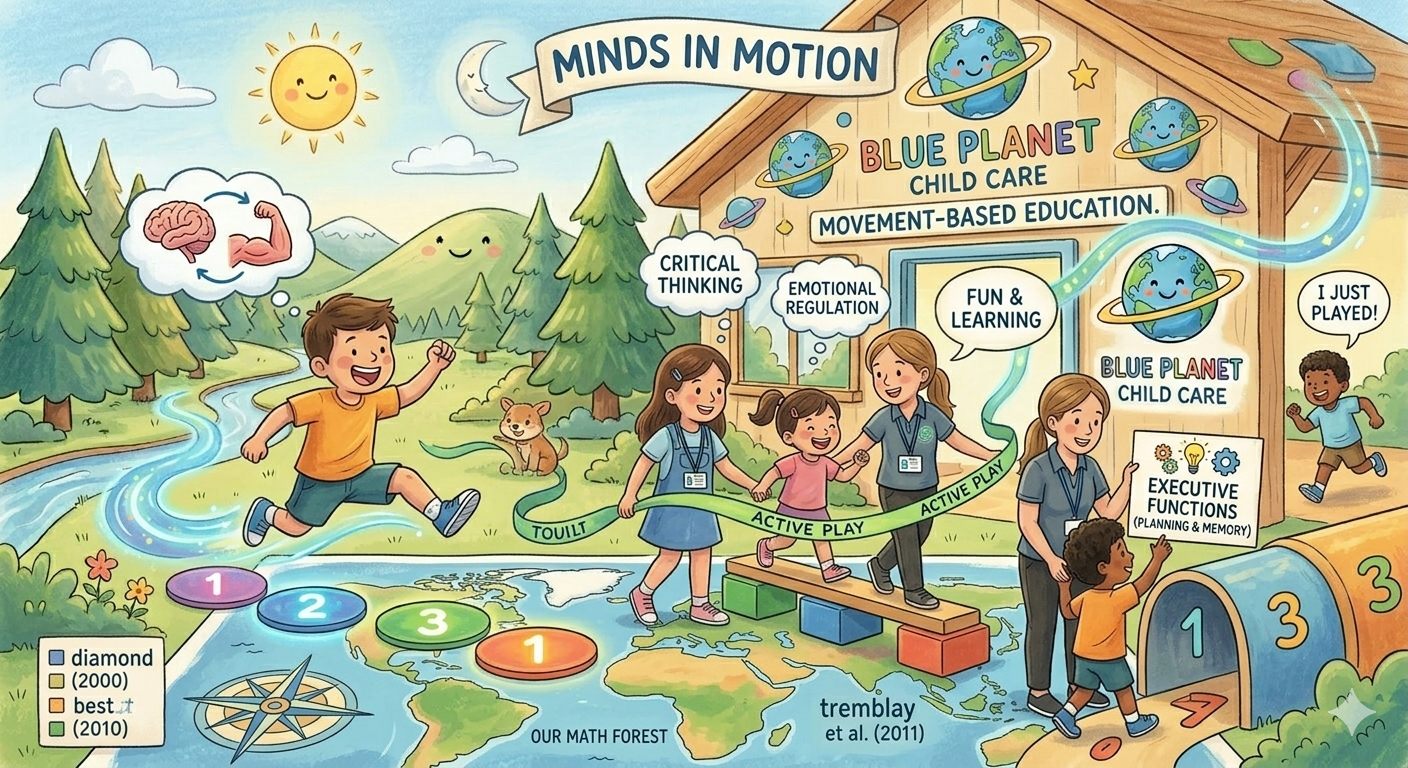
To visualize our philosophy, let’s look at a typical day at Blue Planet with the "Math Forest" obstacle course:
"I Just Played!"
At the end of the day, our children don't go home talking about the academic, physical, or emotional milestones they've achieved. In their eyes, only one thing happened: Pure Fun.
When parents ask, "What did you do today?" and receive the answer "I just played!", we know we have succeeded. True learning occurs when complex developmental goals are hidden within the joy of play and movement.