A Phrase Worth Unpacking
+Enter almost any daycare or early childhood centre in Calgary and you will encounter the phrase "child-centered." It appears on websites, in brochures, in staff training materials. It has become so common that it risks becoming meaningless — a pleasant-sounding label applied to nearly any environment, regardless of what actually happens inside it.
+We want to be honest with you about what it means — and what it requires — because we believe parents deserve more than slogans.
+At Blue Planet Child Care, child-centered learning is not a philosophy we adopted because it sounds good. It is the operational framework of everything we do. And understanding what it genuinely entails helps explain not just how we teach, but why we built the kind of environment we did.
+What Child-Centered Learning Is Not
+Let's begin with a clarification, because the most common misunderstanding is significant: child-centered learning does not mean the absence of structure. It does not mean children do whatever they want. It does not mean educators step back and simply observe.
+In fact, genuinely child-centered practice is more demanding of educators than traditional, teacher-directed instruction. It requires careful observation, responsive adaptation, deep knowledge of child development, and the professional judgment to know when to offer support and when to stand back. It is not passive. It is highly skilled.
+It also does not mean every child receives a completely separate curriculum. Children are profoundly social learners. Group experiences, peer interaction, shared challenges, and collaborative play are not just compatible with child-centered practice — they are essential to it.
+What It Does Mean
+Child-centered learning means that the child — not the curriculum, not the clock, not an external benchmark — is the primary reference point for every educational decision.
+It means asking: What is this specific child ready for today? What are they drawn to? What is causing them difficulty, and why? What do they need in order to feel safe enough to take a risk and try something new?
+It means that a lesson plan is a proposal, not a contract — because the most important learning often happens in the margins, in the unexpected question, in the emotional moment that interrupts the schedule and reveals something far more important than what was planned.
+At its foundation, child-centered learning is an act of profound respect. It says to each child: you are a whole person. You are not a container to be filled with content. You have an inner life, a developmental pace, a unique way of making sense of the world — and all of that matters more than any rubric.
+Blue Planet Is Not a Childcare Centre. It Is a Development Centre.
+This distinction is fundamental to our identity.
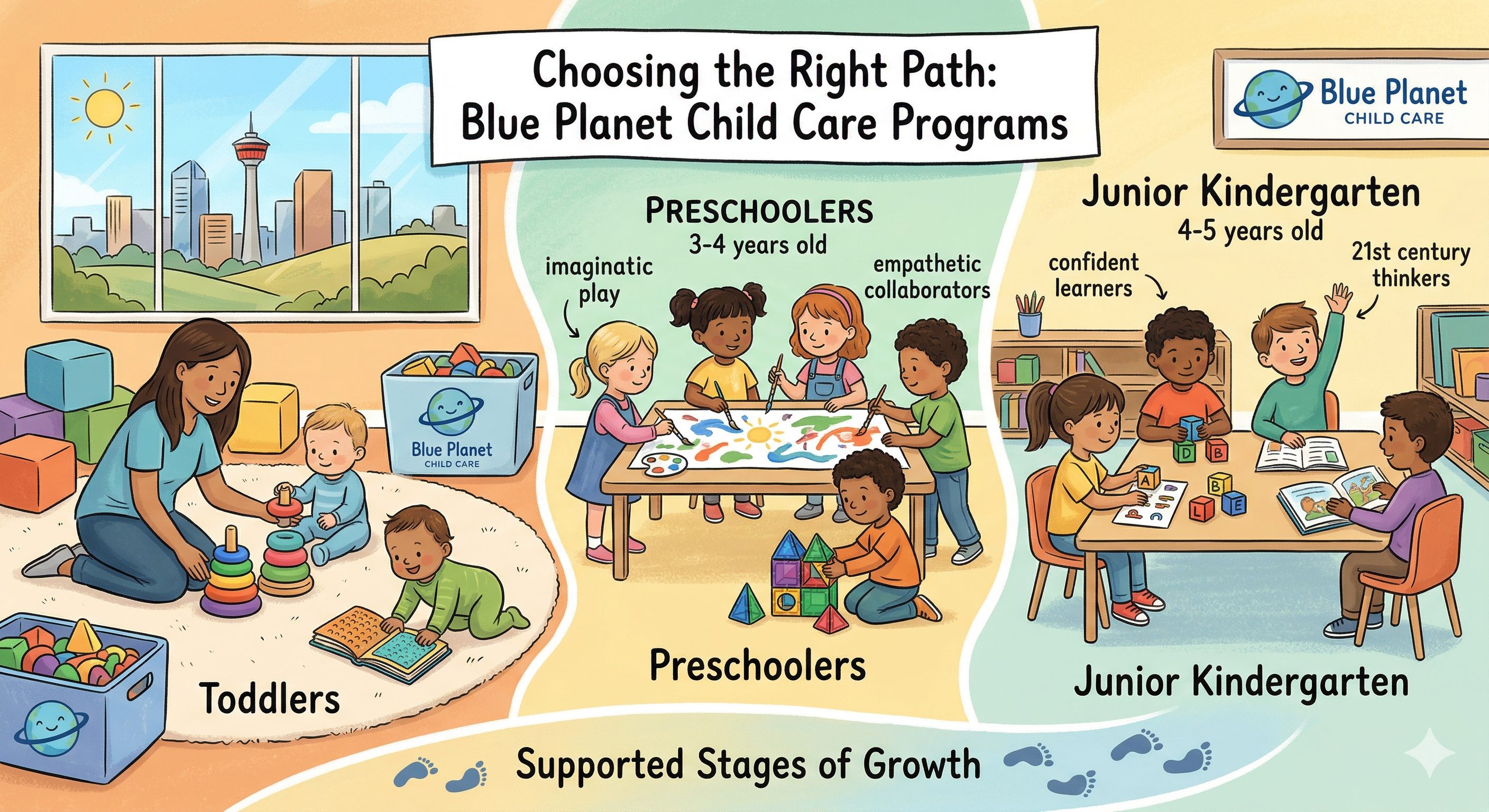
+A childcare centre provides supervision and safety. These are necessary and valuable. But at Blue Planet, we were founded on the conviction that the years between 19 months and 5 years are too developmentally significant to be treated as a holding pattern.
+We support the whole child — cognitive development, social and emotional intelligence, physical growth, creative expression, and the foundational 21st century capacities that will define your child's ability to thrive in a rapidly changing world. These domains are not separate. They are deeply interconnected. A child who is emotionally dysregulated cannot learn effectively. A child who never moves their body is denied one of the most powerful cognitive tools available. A child who is compared to peers and found lacking learns, at the most formative moment of their life, that they are not enough.
+We reject all of that. And we build something different.
+The World Has Changed. Education Must Too.
+We are in the middle of a fundamental shift in what education is for. For most of the 20th century, formal learning was primarily about knowledge transmission: here is information, absorb it, reproduce it. This model made sense in a world where information was scarce and access to it was limited.
+That world no longer exists.
+Today, information is infinitely abundant. What has become scarce — genuinely valuable and differentiating — is the capacity to think critically about information, to evaluate its quality and relevance, to synthesize across domains, to collaborate with others in solving complex problems, and to create genuinely novel responses to novel situations.
+The World Economic Forum's Future of Jobs Report (2023) identifies creativity, complex problem-solving, critical thinking, emotional intelligence, and collaboration as the defining competencies of the coming decades. These are precisely the capacities that child-centered, play-based early learning develops — and precisely the capacities that rote, content-driven instruction does not.
+The future does not belong to the child who memorizes the most facts. It belongs to the child who can think flexibly, feel deeply, adapt quickly, and work generously with others. At Blue Planet, we build those foundations — starting in our Toddler Group at 19 months.
+Understanding the Child — And Making Sure They Feel Understood
+In our increasingly fast-paced, stimulus-saturated world, children face a uniquely modern challenge: the sheer volume of sensory input, social complexity, and environmental change they are asked to navigate is unprecedented in human history.
+Stuart Shanker's research on self-regulation (2016) documents that rising levels of environmental stress — digital stimulation, social complexity, the accelerating pace of modern life — place extraordinary demands on children's developing nervous systems. Children are not struggling because they are deficient. They are struggling because the world around them genuinely demands more than their developing brains are equipped to manage without support.
+At Blue Planet, we take this reality seriously. We do not manage children's emotional experiences — we engage with them. We help children identify and name what they feel. We create space for big emotions without pathologizing them. We look beneath behaviour for the need it expresses, because behaviour is always communication.
+The most important commitment we make — before any curriculum objective, before any developmental milestone, before any parent expectation — is this: every child at Blue Planet will feel genuinely understood. Not just managed. Not just occupied. Understood.
+Siegel and Bryson's work on mindsight and interpersonal neurobiology (2011) supports what our educators practice daily: children develop emotional intelligence not through instruction about emotions, but through emotionally attuned relationships with trusted adults. A child who consistently experiences being seen, named, and responded to — a child who knows that their inner world makes sense to the adults around them — is a child building the internal architecture of resilience, empathy, and self-awareness.
+We pursue this with care and consistency. It is our highest priority, and it is where we invest our deepest professional attention.
+We Do Not Compare Children. We Witness Them.
+The culture of comparison in early childhood is one of the most damaging forces we work against — gently, but consistently.
+Parents receive checklists. Apps send milestone alerts. Well-meaning relatives ask if a child is "talking yet," "reading yet," "ready yet." And children, even very young ones, absorb the anxiety these comparisons generate.
+At Blue Planet, we do not operate within that framework. The only measure that guides our work is this: compared to where this child was when they came to us, where are they now?
+This is the question that matters. Not whether your child is ahead of or behind a developmental average. Not how they compare to the child in the next room. But whether they, as an individual — with their specific strengths, their specific challenges, their specific pace — are growing, flourishing, and becoming more fully themselves.
+Developmental psychologist Jean Piaget's research established that children cannot meaningfully skip the stages of cognitive development. Each stage must be lived fully before the next can be built upon it. Rushing a child through one stage to arrive at the next does not produce advancement — it produces a fragile foundation.
+At Blue Planet, we never push. We invite. We create the conditions for growth, and then we trust children to grow in the way that is right for them. If a child needs more time, we give it. If they are ready to be gently stretched, we stretch them. But always in response to who they are — never in response to who we think they should be by now.
+Your child is not behind. They are exactly where they are. And wherever that is, we start there.
+What Child-Centered Practice Looks Like Every Day
+Concretely, at Blue Planet, child-centered learning expresses itself through:
+Bloom's Taxonomy as a depth framework — ensuring that learning experiences move beyond information recall toward genuine understanding, application, analysis, evaluation, and creation, at each child's level.
+Interdisciplinary learning — connecting art, science, language, mathematics, and physical movement into unified experiences that mirror how children naturally make sense of the world.
+Movement as cognition — embedding physical activity throughout the day, because the body is not separate from the mind, and learning through movement is not an accommodation — it is developmentally optimal practice.
+The Orff method in music — treating music as a participatory language, not a performance, and developing rhythm, creativity, and listening as core capacities.
+Purposeful play and free play in balance — because both serve essential developmental functions, and neither can substitute for the other.
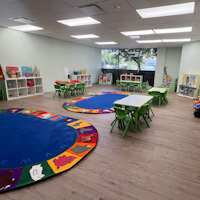
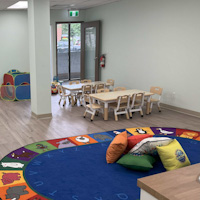
+Small group sizes and consistent educators — because child-centered care is structurally impossible when children are not truly known by the adults who work with them.
+Coding and logical thinking in Junior Kindergarten — because the 21st century demands that children develop the habit of structured, sequential reasoning from the earliest possible stage.
+Blue Planet: Where Every Child Is Their Own Planet
+The name Blue Planet is not accidental. Just as Earth, seen from space, is a singular, irreplaceable, self-contained world — so is every child. Unique. Bright. Full of systems and weather and interior life that cannot be fully mapped from the outside.
+Our job is not to make all children the same. It is to understand each one as the particular world they are — and to create an environment where that world can flourish.
+In an age where information is everywhere and wisdom is rare, where change is constant and resilience is everything, where the most valuable human capacities are precisely the ones that cannot be automated — child-centered learning is not a pedagogical preference. It is a necessity.
+At Blue Planet Child Care, 1212 1st St SE, downtown Calgary, we practice it every day.
+Come see it for yourself. Contact us to book a visit, check our FAQ for common questions, or join our waitlist.
++
📚 Academic References:
+- +
- Bloom, B. S. (1956). Taxonomy of Educational Objectives. David McKay Company. +
- Piaget, J. (1952). The Origins of Intelligence in Children. International Universities Press. +
- Shanker, S. (2016). Self-Reg: How to Help Your Child (and You) Break the Stress Cycle. Penguin Press. +
- Siegel, D. J., & Bryson, T. P. (2011). The Whole-Brain Child. Delacorte Press. +
- Vygotsky, L. S. (1978). Mind in Society. Harvard University Press. +
- World Economic Forum. (2023). Future of Jobs Report. WEF. +
- Robinson, K. (2011). Out of Our Minds: Learning to Be Creative. Capstone. +